Start with the machine duty, not with a chain number
A roller chain drive is a system: chain, sprockets, shafts, center distance, guard, lubrication, and environment must work together. Selecting only by pitch or tensile strength can produce a drive that wears rapidly or does not fit the machine.
Before opening a catalog, record the transmitted power, driver and driven shaft speeds, shaft diameters, load character, desired ratio, center distance, available sprocket envelope, operating hours or duty pattern, contamination, corrosion exposure, temperature, and access for lubrication and inspection. For a replacement, record the existing chain marking and inspect both sprockets before repeating the old size.
The transmission chain range can be used to identify likely product families, but the final size must still be verified against the selected manufacturer’s power-rating table and dimensional drawing.
Step 1 — Convert real duty into design power
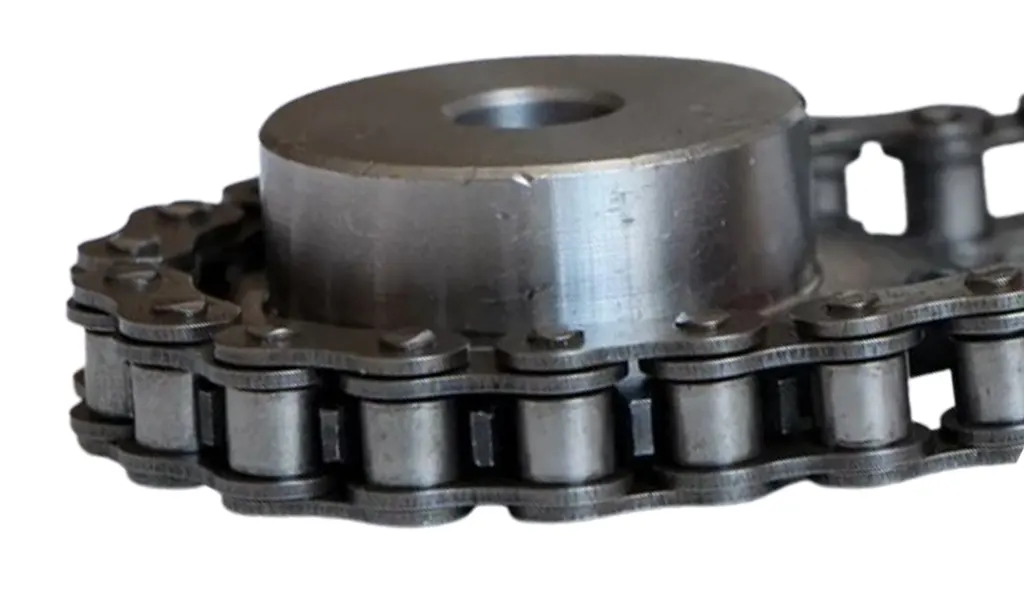
Begin with the power the chain actually has to transmit. If only motor nameplate power is available, state that assumption and identify whether the driven equipment can impose shock, repeated starts, reversals, jams, or cyclic torque. Smooth and shock-loaded machines should not automatically receive the same chain selection at the same kW rating.
Use the service factor from the chain manufacturer’s own selection method for the combination of prime mover and driven machine. Then calculate the design value for its rating chart.
Fatigue loading and joint pressure may exceed what the chain rating method is intended to handle, especially during starts or shock events.
A larger pitch or excessive strand count can increase sprocket diameter, chain mass, cost, and packaging difficulty without correcting poor lubrication or alignment.
Step 2 — Connect shaft RPM, speed ratio, and chain speed
Speed matters twice: it sets the transmission ratio together with sprocket tooth counts, and it determines how rapidly each pin-bushing joint articulates. That affects both rating and lubrication.
v = chain speed in m/min; p = pitch in mm; z = driving sprocket teeth; n = driving sprocket rpm.
For a simple two-sprocket drive, shaft speed ratio is the inverse of sprocket tooth-count ratio.
Do not use the ratio equation alone. A tooth count that gives the right RPM can still create a small sprocket outside the rating method or a large sprocket that conflicts with the machine envelope. Check ratio, pitch, and the physical envelope together.
Step 3 — Select chain pitch and the small sprocket as a pair
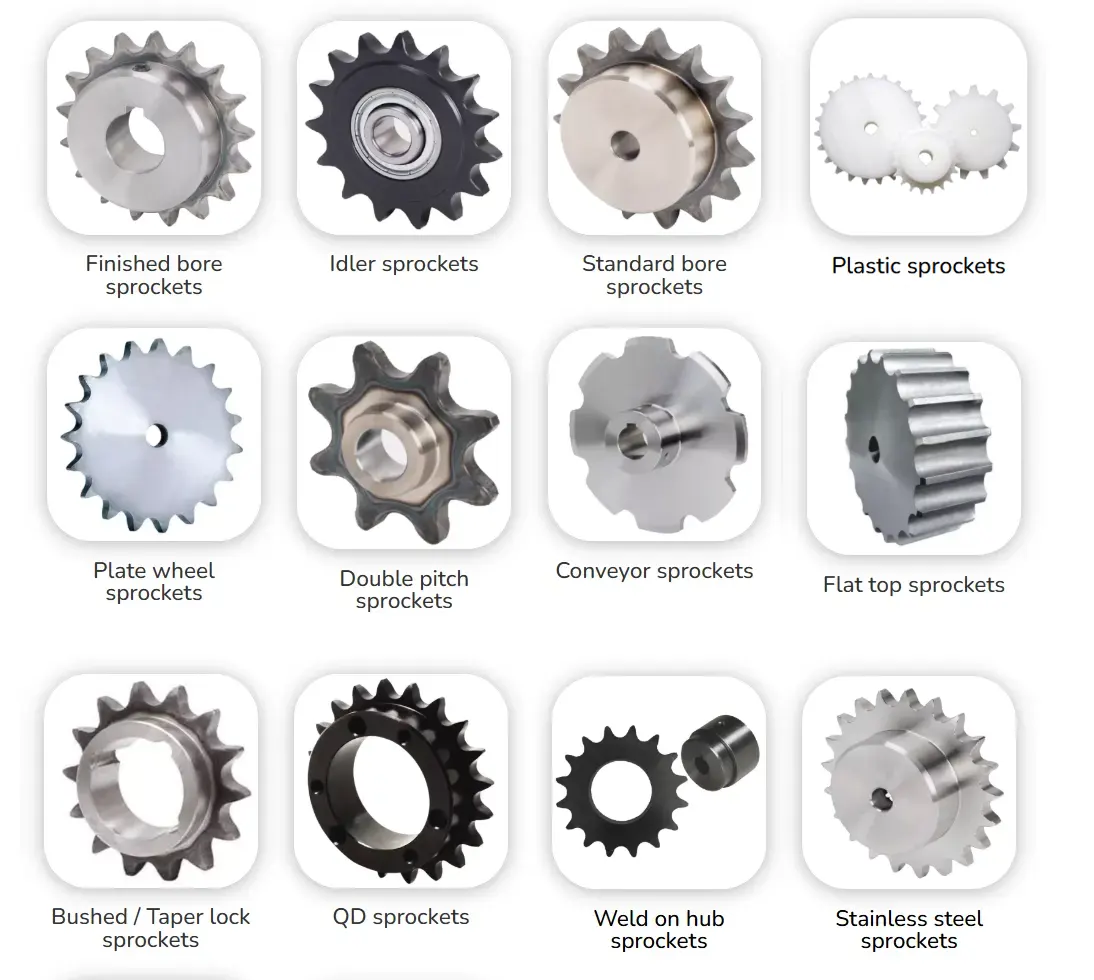
The chain pitch affects strength, articulation, sprocket diameter, and overall drive size. A larger pitch is not automatically better for heavy duty. A smaller pitch chain on a sprocket with more teeth can produce a smoother drive and may package more effectively, especially when multiple strands are available.
The small sprocket is critical because each joint changes direction there. Very low tooth counts increase polygonal speed variation and joint articulation. Instead of forcing a low tooth count merely to fit the machine, compare a smaller pitch, a different strand count, or a revised center distance. Use a tooth count supported by the selected manufacturer’s rating table.
For examples of simplex, duplex, and triplex packaging, a duplex roller chain sprocket reference can help with layout planning. Use the exact chain and sprocket drawing for final dimensions.
Step 4 — Decide whether simplex, duplex, or triplex fits better
If simplex does not meet design power at a practical pitch and sprocket size, compare a multiple-strand option before moving to a much larger pitch. Multiple strands can keep sprocket diameter compact, but they increase drive width and alignment demands.
Simplest package and narrowest sprocket. Prefer when one strand satisfies the rating and space constraints.
Useful when a smaller pitch is attractive but one strand is not enough. Check transverse pitch, sprocket width, and shaft length.
Can raise capacity further, but alignment, width, lubrication access, and cost become more important.
Step 5 — Make center distance, chain length, and adjustment work in the real machine
Center distance is more than a layout dimension. It affects chain length, sprocket wrap, unsupported span length, guard geometry, and how much take-up movement is available as the chain wears. Fixed-center drives need especially careful chain-length planning because shaft position cannot absorb a mismatch.
After provisional tooth counts are known, calculate chain length with the manufacturer’s method or design software and convert it to an installable number of pitches. Confirm that shaft centers, guard, and take-up can accept it. If an offset link appears necessary, confirm that it is permitted for the selected chain series and duty.
- Wrap
- Confirm the chain engages enough teeth on the small sprocket for the chosen layout and direction of rotation.
- Take-up
- Provide practical adjustment for installation and wear compensation without forcing the shafts out of alignment.
- Clearance
- Check both tight and slack spans against guards, brackets, frame members, and adjacent rotating parts.
Step 6 — Treat lubrication and environment as rating inputs
Select the lubrication method during design, not after installation. The working lubricant needs to reach the articulating pin-bushing region. A chain can have adequate nominal strength and still wear quickly if its operating point calls for a lubrication system that the machine does not provide.
Use the supplier’s lubrication chart for chain size, sprocket speed, and load. Manual, drip, bath/disc, and forced systems are not interchangeable at every operating point.
Water, washdown chemicals, salt, abrasive dust, product contamination, or restricted lubricant use can change the material, coating, sealing, and maintenance strategy.
Special materials, coatings, and low-maintenance chains are not universal substitutes. Verify their capacity, corrosion, temperature, and lubrication limits for the actual environment; joint lubrication remains a key wear-control factor.
Step 7 — Verify sprocket compatibility and all interfaces before ordering
Replacement compatibility requires more than pitch. Confirm the chain standard and series, roller diameter, inner width, strand count, transverse pitch for multi-strand chain, and matching sprocket tooth form. For the sprockets, verify tooth count, bore, locking method, hub width, outside diameter, runout requirement, and shaft engagement.
| Input | How to obtain it | What it changes | Final check |
|---|---|---|---|
| Transmitted power + duty | Drive data and machine load history | Design power through service factor | Rating-table operating point |
| Driver / driven RPM | Nameplate, controller setting, or tachometer | Ratio, chain speed, lubrication | Maximum operating speed included |
| Pitch + small sprocket | Manufacturer selection chart | Capacity, smoothness, diameter | Teeth and sprocket diameter fit |
| Center distance | Layout drawing or measurement | Chain length, wrap, take-up | Installable whole-pitch length |
| Environment + lubrication | Site conditions and maintenance plan | Material and lubrication method | Supplier limits and lubricant compatibility |
| Release gate | Capacity, geometry, compatibility, and lubrication must all pass before the chain is released for purchase. | ||
Worked example — narrow the drive without pretending to know the final chain size
Assume a 7.5 kW drive at 250 rpm with an 18-tooth provisional driving sprocket and 19.05 mm pitch. Suppose the selected manufacturer’s service table gives 1.3 for this duty; another catalog or application may require a different factor.
7.5 kW × 1.3 = 9.75 kW. Use 9.75 kW and the relevant shaft speed when entering that manufacturer’s rating table.
19.05 × 18 × 250 / 1000 = 85.7 m/min. Use this operating speed to check rating and lubrication requirements.
F = 60,000P/v = 60,000 × 7.5 / 85.7 ≈ 5.25 kN. This does not choose the chain by itself; it is a useful physical check on the transmitted load.
Now compare the combinations offered by the selected manufacturer’s rating chart. If a viable simplex chain requires a sprocket too large for the frame, compare a smaller-pitch duplex option. If duplex is too wide, test another rated combination rather than reducing tooth count blindly. Then check exact chain length, sprocket interfaces, center distance, and lubrication.
Six selection mistakes that cause expensive rework
Roller chain selection FAQ
Can I select a roller chain from motor power alone?
Is a larger roller-chain pitch always better for a heavy load?
How many teeth should the small sprocket have?
When does duplex make more sense than simplex?
What information should I send to a chain supplier?
Finish with four verification gates, not a guessed chain number
Release the drive only when capacity, geometry, sprocket compatibility, and lubrication all pass together. For product-family context and manufacturing options, review our industrial chain drive solutions. For a project-specific check, provide the operating data, existing markings, and machine layout before requesting a final chain and sprocket specification.