Description du produit
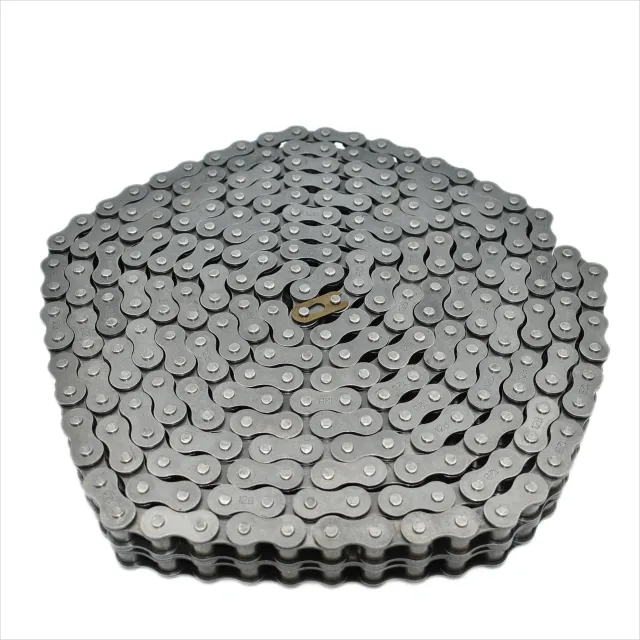
Chaîne à rouleaux Simplex en acier inoxydable 304 (08B-1, 24B-1)
La chaîne la plus couramment utilisée est la chaîne à rouleaux, également appelée chaîne de transmission. Il s'agit du système de transmission par chaîne le plus simple, principalement utilisé pour la transmission de puissance. Elle est disponible avec un pas de 3 mm à 4 pouces, en acier doux ou en acier inoxydable.
Nous possédons des équipements sophistiqués et des technologies de pointe, tels que :
1. Concepteur CAO
2. Machine à couper le fil
3. Chaîne fonctionnant dans la machine
4. Four à convoyeur
5. Dérive de la balle
6. Pièces grenaillées
7. Conception de la taille de la plaque de liaison
Détails de l'emballage :
Détails de l'entreprise :
TAI is 1 of a professional exporter with exporting PIÈCES DE TRANSMISSION DE PUISSANCE : Chaînes à rouleaux, chaînes de convoyeur, chaînes en acier inoxydable, chaînes agricoles, chaînes détachables en acier, chaînes spéciales, pignons, pignons en acier inoxydable, accouplements HRC, poulies, bagues, etc. Tous ces produits sont fournis régulièrement à l’international depuis plus de 15 ans.
N'hésitez pas à nous contacter pour plus de détails.
Ava Gao(Sales)
Tran-Auto Industries Co.,Limited
716 Gold River Center, n° 88, Shishan Rd.,
Nouveau district, Hangzhou, République populaire de Chine. Code postal : 215011
Tel: -512-6583
transmission automatique
| DIN/ISO Numéro de chaîne |
Pas | Rouleau Diamètre |
Width Between Inner Plates |
Pin Diameter |
Pin Length |
Inner Plate depth |
Plate thick ness |
Ultime traction Force |
Moyenne traction Force |
Weight Per Meter |
|
| Mm | mm | mm | mm | mm | mm | mm | mm | kN/LB | kN | kg/m | |
| 04B-1 | 6.000 | 4.00 | 2.80 | 1.85 | 6.80 | 7.80 | 5.00 | 0.60 | 3.0/682 | 3.2 | 0.11 |
| 05B-1 | 8.000 | 5.00 | 3.00 | 2.31 | 8.20 | 8.90 | 7.10 | 0.80 | 5.0/1136 | 5.9 | 0.20 |
| *06B-1 | 9.525 | 6.35 | 5.72 | 3.28 | 13.15 | 14.10 | 8.20 | 1.30 | 9.0/2045 | 10.4 | 0.41 |
| 08B-1 | 12.700 | 8.51 | 7.75 | 4.45 | 16.70 | 18.20 | 11.80 | 1.60 | 18.0/4091 | 19.40 | 0.69 |
| 10B-1 | 15.875 | 10.16 | 9.65 | 5.09 | 19.50 | 20.90 | 14.70 | 1.70 | 22.4/5091 | 27.50 | 0.93 |
| 12B-1 | 19.050 | 12.07 | 11.68 | 5.72 | 22.50 | 24.2 | 16.00 | 1.85 | 29.0/6591 | 32.20 | 1.15 |
| 16B-1 | 25.400 | 15.88 | 17.02 | 8.28 | 36.10 | 37.4 | 21.00 | 4.15/3.1 | 60.0/13636 | 72.80 | 2.71 |
| 20B-1 | 31.750 | 19.05 | 19.56 | 10.19 | 41.30 | 45.0 | 26.40 | 4.5/3.5 | 95.0/21591 | 106.7 | 3.70 |
| 24B-1 | 38.100 | 25.40 | 25.40 | 14.63 | 53.40 | 57.80 | 33.20 | 6.0/4.8 | 160.0/36364 | 178.0 | 7.10 |
| 28B-1 | 44.450 | 27.94 | 30.99 | 15.90 | 65.10 | 69.50 | 36.70 | 7.5/6.0 | 200.0/45455 | 222.0 | 8.50 |
| 32B-1 | 50.800 | 29.21 | 30.99 | 17.81 | 66.00 | 71.0 | 42.00 | 7.0/6.0 | 250.0/56818 | 277.5 | 10.25 |
| 40B-1 | 63.50 | 39.37 | 38.10 | 22.89 | 82.20 | 89.2 | 52.96 | 8.5/8.0 | 355.0/80682 | 394.0 | 16.35 |
| 48B-1 | 76.20 | 48.26 | 45.72 | 29.24 | 99.10 | 107.0 | 63.80 | 12.0/10.0 | 560.0/127272 | 621.6 | 25.00 |
| 56B-1 | 88.90 | 53.98 | 53.34 | 34.32 | 114.60 | 123.0 | 77.80 | 13.5/12.0 | 850.0/193180 | 940.0 | 35.78 |
| *Bushing chain: d1 in the table indicate the external diameter of bushing |
|||||||||||
| Usage: | Chaîne de transmission |
|---|---|
| Matériel: | Acier inoxydable |
| Traitement de surface : | Polissage |
| Fonctionnalité: | Résistant à la chaleur |
| Taille de la chaîne : | 1/2"*3/32" |
| Structure: | Chaîne à rouleaux |
| Personnalisation : |
Disponible
| Demande personnalisée |
|---|

Les chaînes de transmission peuvent-elles être utilisées dans des environnements à haute température ?
Oui, les chaînes de transmission peuvent être utilisées dans des environnements à haute température, mais il convient de tenir compte de certains points. Voici une explication détaillée :
1. Choix des matériaux : En environnement à haute température, il est essentiel de choisir des chaînes de transmission fabriquées à partir de matériaux résistants à la chaleur. Parmi les matériaux couramment utilisés pour les applications à haute température, on trouve les aciers alliés traités thermiquement, les aciers inoxydables et les alliages spéciaux résistants à la chaleur. Ces matériaux offrent une meilleure résistance à la dilatation thermique, à l’oxydation et à la déformation à haute température.
2. Lubrification : Une lubrification adéquate est essentielle au bon fonctionnement et à la longévité des chaînes de transmission en environnement à haute température. Il convient d’utiliser des lubrifiants haute température à stabilité thermique supérieure afin de garantir une lubrification optimale et de minimiser la génération de chaleur par frottement. Ces lubrifiants sont spécialement formulés pour résister aux températures élevées et assurer une lubrification efficace, réduisant ainsi l’usure et prolongeant la durée de vie de la chaîne.
3. Conception de la chaîne : La conception des chaînes de transmission pour environnements à haute température peut intégrer des caractéristiques visant à améliorer leur résistance à la chaleur. Il peut s’agir de revêtements résistants à la chaleur, de traitements thermiques spécifiques et de propriétés de dissipation thermique optimisées. De plus, la capacité de charge, la résistance à la fatigue et la stabilité dimensionnelle de la chaîne doivent être soigneusement étudiées afin de garantir un fonctionnement fiable sous contraintes thermiques.
4. Limites de température : Il est important de connaître les limites de température spécifiées par le fabricant pour une chaîne de transmission donnée. Chaque chaîne possède sa propre plage de températures de fonctionnement optimale. Le dépassement des limites de température recommandées peut entraîner la rupture de la chaîne, une diminution de sa résistance, une usure accélérée et des dommages potentiels aux composants environnants.
5. Inspection et entretien réguliers : L’inspection et l’entretien réguliers sont essentiels pour surveiller l’état des chaînes de transmission dans les environnements à haute température. Des inspections périodiques permettent de détecter les signes d’usure, d’allongement ou de dommages causés par les contraintes thermiques. Le remplacement rapide des chaînes usées ou endommagées, ainsi qu’une lubrification et un réglage de tension appropriés, contribuent à garantir un fonctionnement fiable et continu.
Il est important de consulter les fabricants de chaînes ou des experts du secteur pour choisir la chaîne de transmission appropriée et s'assurer de sa compatibilité avec l'application haute température prévue. Le respect des recommandations du fabricant, une installation correcte et un entretien régulier contribueront à une utilisation sûre et efficace des chaînes de transmission en environnements à haute température.
Quels sont les avantages de l'utilisation d'une chaîne de transmission autonettoyante ?
L'utilisation d'une chaîne de transmission autonettoyante offre plusieurs avantages, qui sont détaillés ci-dessous :
1. Performances améliorées : Les chaînes de transmission autonettoyantes sont conçues pour éliminer efficacement les débris, la saleté et les contaminants qui peuvent s’accumuler sur la chaîne pendant son fonctionnement. En maintenant la chaîne propre, on assure des performances optimales et on prévient l’accumulation de débris qui peuvent affecter son mouvement, son engrènement avec les pignons et l’efficacité globale.
2. Maintenance réduite : Grâce à une chaîne de transmission autonettoyante, la fréquence des nettoyages et de l’entretien manuels est considérablement réduite. La conception de la chaîne intègre des éléments tels que des plaques de forme spéciale, des barres latérales incurvées et d’autres composants qui empêchent activement les débris d’adhérer à la chaîne ou de pénétrer dans ses zones critiques. Ceci réduit le temps et les efforts nécessaires aux opérations de nettoyage et d’entretien, ce qui engendre des économies et une productivité accrue.
3. Durée de vie prolongée de la chaîne : Le mécanisme autonettoyant de ces chaînes contribue à prolonger leur durée de vie. En éliminant efficacement les débris et en empêchant l’accumulation de contaminants, la chaîne s’use moins. Il en résulte une réduction de l’allongement de la chaîne, une diminution des frottements internes et une réduction du risque de défaillance prématurée. Par conséquent, la durabilité et la longévité globales de la chaîne sont améliorées.
4. Fiabilité accrue : Les chaînes de transmission autonettoyantes contribuent à une fiabilité accrue et à des performances constantes. L’absence d’accumulation de débris assure un engrènement fluide avec les pignons, évitant ainsi le glissement, le blocage ou les interruptions soudaines de la transmission de puissance. Le fonctionnement fiable de la chaîne se traduit par une disponibilité optimisée, des temps d’arrêt réduits et une efficacité globale du système accrue.
5. Adaptées aux environnements difficiles : Les industries et applications opérant dans des environnements riches en poussière, saletés ou autres particules bénéficient grandement des chaînes de transmission autonettoyantes. Elles sont couramment utilisées dans des secteurs tels que l’agriculture, la construction, l’exploitation minière et la manutention, où l’exposition à des environnements difficiles est fréquente. La fonction autonettoyante contribue à maintenir les performances et la fiabilité de la chaîne, même dans ces conditions extrêmes.
Il est important de noter que, malgré les avantages considérables qu'offrent les chaînes de transmission autonettoyantes, un contrôle et un entretien réguliers restent indispensables pour garantir leur fonctionnement optimal. La surveillance de l'état de la chaîne, l'application d'une lubrification appropriée et la réparation de tout signe d'usure ou de dommage sont essentielles pour optimiser les performances des chaînes de transmission autonettoyantes et assurer leur fiabilité à long terme.
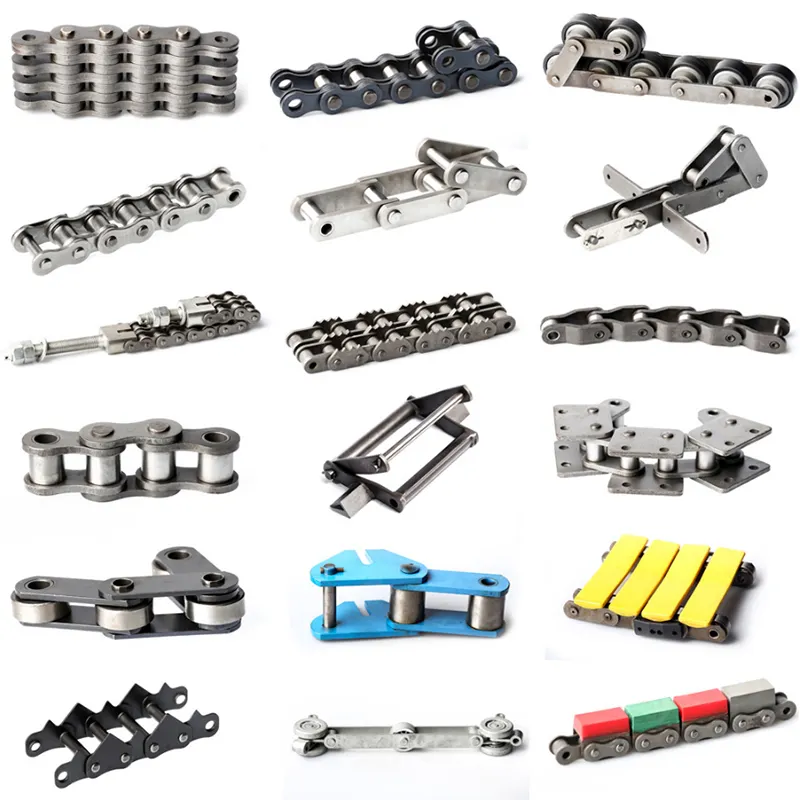
Quels sont les différents types de chaînes de transmission disponibles ?
Il existe plusieurs types de chaînes de transmission, chacune conçue pour des applications et des conditions de fonctionnement spécifiques. Voici quelques types courants :
- Chaînes à rouleaux : Les chaînes à rouleaux sont le type de chaînes de transmission le plus répandu. Elles se composent de plaques intérieures et extérieures, d’axes, de bagues et de rouleaux. Ces derniers contribuent à réduire la friction et à assurer un mouvement fluide.
- Chaînes silencieuses : Les chaînes silencieuses, également appelées chaînes à denture inversée ou chaînes crantées, sont dotées de profils de dents spécifiques qui s’engrènent avec des pignons correspondants. Elles sont conçues pour minimiser le bruit et les vibrations, ce qui les rend idéales pour les applications exigeant un fonctionnement silencieux.
- Chaînes à maillons plats : Les chaînes à maillons plats sont constituées de maillons imbriqués en tôle d’acier. Elles sont reconnues pour leur haute résistance à la traction et à la fatigue, ce qui les rend idéales pour les applications exigeantes et soumises à des charges importantes.
- Chaînes de distribution : Les chaînes de distribution servent à synchroniser la rotation de l’arbre à cames et du vilebrequin dans les moteurs. Leurs dents, au profil précis, s’engrènent avec les pignons de distribution, assurant ainsi un calage précis et un rendement moteur optimal.
- Chaînes en acier technique : Les chaînes en acier technique sont des chaînes hautement spécialisées, conçues pour des industries et des applications spécifiques. Elles sont souvent utilisées dans des environnements exigeants tels que les mines, la foresterie et la manutention.
- Chaînes en plastique : Fabriquées à partir de matériaux plastiques haute résistance comme l’acétal ou le nylon, les chaînes en plastique présentent l’avantage d’être résistantes à la corrosion, légères et silencieuses. Elles sont couramment utilisées dans l’industrie agroalimentaire, l’emballage et d’autres secteurs soumis à des exigences d’hygiène strictes.
Ce ne sont là que quelques exemples de types de chaînes de transmission. Selon l'application, d'autres chaînes spécialisées peuvent être disponibles pour répondre aux exigences spécifiques de différents secteurs et machines.
En quoi les chaînes à rouleaux diffèrent-elles des autres types de chaînes de transmission ?
Les chaînes à rouleaux, également appelées chaînes à maillons à rouleaux, sont un type de chaîne de transmission couramment utilisé qui se distingue des autres chaînes de plusieurs manières :
- Conception : Les chaînes à rouleaux sont composées de plaques intérieure et extérieure, d’axes, de bagues et de rouleaux. La rotation libre des rouleaux contribue à réduire la friction et l’usure, assurant ainsi une transmission de puissance plus fluide et plus efficace.
- Large champ d'application : Les chaînes à rouleaux sont polyvalentes et largement utilisées dans diverses industries, notamment l'automobile, les machines industrielles, les équipements agricoles et les systèmes de convoyage.
- Capacité de charge élevée : les chaînes à rouleaux sont conçues pour supporter des charges élevées et offrent une excellente résistance à la traction, ce qui les rend adaptées aux applications exigeant des performances robustes.
- Efficacité : Les chaînes à rouleaux sont reconnues pour leur haute efficacité de transmission de puissance. La conception des rouleaux minimise les frottements, ce qui réduit les pertes d’énergie et améliore l’efficacité globale.
- Rapport coût-efficacité : Les chaînes à rouleaux sont relativement économiques par rapport à certaines autres chaînes de transmission spécialisées, ce qui en fait un choix populaire dans de nombreuses applications.
Bien que les chaînes à rouleaux présentent des avantages, il est important de noter que différents types de chaînes de transmission peuvent être plus adaptés à des applications spécifiques. Des facteurs tels que la capacité de charge, la vitesse, le niveau sonore et les conditions environnementales doivent être pris en compte lors du choix de la chaîne de transmission appropriée à une application particulière.


Édité par CX le 16/08/2023