Descripción del Producto
Cadena de rodillos Simplex de acero inoxidable 304 (08B-1, 24B-1)
La cadena más utilizada es la de rodillos, también conocida como cadena de transmisión. Se trata de los sistemas de transmisión por cadena más sencillos, empleados principalmente para la transmisión de potencia. Se pueden suministrar con pasos de 3 mm a 4 pulgadas, tanto en acero dulce como en acero inoxidable.
Contamos con equipos sofisticados y tecnología avanzada, tales como:
1. Diseñador CAD
2. Máquina cortadora de alambre
3. Cadena funcionando en la máquina
4. Horno transportador
5. Desviación de la bola
6. Piezas granalladas
7. Diseño de la placa de enlace de la cintura
Detalles del paquete:
Información de la empresa:
TAI es uno de los exportadores profesionales con experiencia en exportación. COMPONENTES DE TRANSMISIÓN DE POTENCIA: Cadenas de rodillos, cadenas transportadoras, cadenas de acero inoxidable, cadenas agrícolas, cadenas de acero desmontables, cadenas especiales, piñones, piñones de acero inoxidable, acoplamientos HRC, poleas, casquillos, etc. Todos estos productos se han suministrado regularmente a nivel mundial durante más de 15 años.
Contáctenos para obtener más detalles.
Ava Gao (Ventas)
Compañía de Industrias Automotrices, Limitada
716 Gold River Center, NO.88 Shishan Rd.,
Nuevo Distrito, Hangzhou, República Popular China. Código postal: 215011
Teléfono: -512-6583
trans-auto
| DIN/ISO Número de cadena |
Paso | Rodillo Diámetro |
Ancho entre Placas internas |
Diámetro del pasador |
Longitud del pasador |
Profundidad de la placa interior |
Placa gruesa ness |
Último De tensión Fortaleza |
Promedio De tensión Fortaleza |
Peso por metro |
|
| Mm | mm | mm | mm | mm | mm | mm | mm | kN/LB | kN | kg/m | |
| 04B-1 | 6.000 | 4.00 | 2.80 | 1.85 | 6.80 | 7.80 | 5.00 | 0.60 | 3.0/682 | 3.2 | 0.11 |
| 05B-1 | 8.000 | 5.00 | 3.00 | 2.31 | 8.20 | 8.90 | 7.10 | 0.80 | 5.0/1136 | 5.9 | 0.20 |
| *06B-1 | 9.525 | 6.35 | 5.72 | 3.28 | 13.15 | 14.10 | 8.20 | 1.30 | 9.0/2045 | 10.4 | 0.41 |
| 08B-1 | 12.700 | 8.51 | 7.75 | 4.45 | 16.70 | 18.20 | 11.80 | 1.60 | 18.0/4091 | 19.40 | 0.69 |
| 10B-1 | 15.875 | 10.16 | 9.65 | 5.09 | 19.50 | 20.90 | 14.70 | 1.70 | 22.4/5091 | 27.50 | 0.93 |
| 12B-1 | 19.050 | 12.07 | 11.68 | 5.72 | 22.50 | 24.2 | 16.00 | 1.85 | 29.0/6591 | 32.20 | 1.15 |
| 16B-1 | 25.400 | 15.88 | 17.02 | 8.28 | 36.10 | 37.4 | 21.00 | 4.15/3.1 | 60.0/13636 | 72.80 | 2.71 |
| 20B-1 | 31.750 | 19.05 | 19.56 | 10.19 | 41.30 | 45.0 | 26.40 | 4.5/3.5 | 95.0/21591 | 106.7 | 3.70 |
| 24B-1 | 38.100 | 25.40 | 25.40 | 14.63 | 53.40 | 57.80 | 33.20 | 6.0/4.8 | 160.0/36364 | 178.0 | 7.10 |
| 28B-1 | 44.450 | 27.94 | 30.99 | 15.90 | 65.10 | 69.50 | 36.70 | 7.5/6.0 | 200.0/45455 | 222.0 | 8.50 |
| 32B-1 | 50.800 | 29.21 | 30.99 | 17.81 | 66.00 | 71.0 | 42.00 | 7.0/6.0 | 250.0/56818 | 277.5 | 10.25 |
| 40B-1 | 63.50 | 39.37 | 38.10 | 22.89 | 82.20 | 89.2 | 52.96 | 8.5/8.0 | 355.0/80682 | 394.0 | 16.35 |
| 48B-1 | 76.20 | 48.26 | 45.72 | 29.24 | 99.10 | 107.0 | 63.80 | 12.0/10.0 | 560.0/127272 | 621.6 | 25.00 |
| 56B-1 | 88.90 | 53.98 | 53.34 | 34.32 | 114.60 | 123.0 | 77.80 | 13.5/12.0 | 850.0/193180 | 940.0 | 35.78 |
| *Cadena de bujes: d1 en la tabla indica el diámetro exterior del buje. |
|||||||||||
| Uso: | Cadena de transmisión |
|---|---|
| Material: | Acero inoxidable |
| Tratamiento de superficie: | Pulido |
| Característica: | Resistente al calor |
| Tamaño de la cadena: | 1/2"*3/32" |
| Estructura: | Cadena de rodillos |
| Personalización: |
Disponible
| Solicitud personalizada |
|---|

¿Se pueden utilizar las cadenas de transmisión en entornos de alta temperatura?
Sí, las cadenas de transmisión se pueden usar en entornos de alta temperatura, pero hay ciertas consideraciones que se deben tener en cuenta. Aquí les ofrecemos una explicación detallada:
1. Selección de materiales: Al operar en entornos de alta temperatura, es fundamental seleccionar cadenas de transmisión fabricadas con materiales resistentes al calor. Entre los materiales comunes para aplicaciones de alta temperatura se incluyen aceros aleados tratados térmicamente, aceros inoxidables y aleaciones especiales resistentes al calor. Estos materiales ofrecen mayor resistencia a la dilatación térmica, la oxidación y la deformación a temperaturas elevadas.
2. Lubricación: Una lubricación adecuada es esencial para el rendimiento y la durabilidad de las cadenas de transmisión en entornos de alta temperatura. Se deben utilizar lubricantes de alta temperatura con excelente estabilidad térmica para garantizar una lubricación óptima y minimizar la generación de calor por fricción. Estos lubricantes están formulados específicamente para soportar temperaturas elevadas y proporcionar una lubricación eficaz, reduciendo el desgaste y prolongando la vida útil de la cadena.
3. Diseño de la cadena: El diseño de cadenas de transmisión para entornos de alta temperatura puede incorporar características que mejoren la resistencia al calor. Estas características pueden incluir recubrimientos resistentes al calor, procesos de tratamiento térmico especializados y mejores propiedades de disipación de calor. Además, se debe considerar cuidadosamente la capacidad de carga, la resistencia a la fatiga y la estabilidad dimensional de la cadena para garantizar un funcionamiento fiable bajo estrés térmico.
4. Límites de temperatura: Es importante conocer los límites de temperatura especificados por el fabricante para una cadena de transmisión en particular. Cada cadena tiene un rango de temperatura de funcionamiento seguro distinto. Superar los límites de temperatura recomendados puede provocar fallas en la cadena, menor resistencia, desgaste acelerado y posibles daños a los componentes circundantes.
5. Inspección y mantenimiento regulares: La inspección y el mantenimiento regulares son cruciales para controlar el estado de las cadenas de transmisión en entornos de alta temperatura. Las inspecciones periódicas permiten detectar signos de desgaste, elongación o daños causados por el estrés térmico. El reemplazo inmediato de las cadenas desgastadas o dañadas, así como la lubricación y el ajuste de tensión adecuados, contribuirán a garantizar un funcionamiento fiable y continuo.
Es importante consultar con fabricantes de cadenas o expertos del sector para seleccionar la cadena de transmisión adecuada y garantizar su compatibilidad con la aplicación específica de alta temperatura. Seguir las instrucciones del fabricante, realizar una instalación correcta y llevar un mantenimiento regular contribuirá al uso seguro y eficiente de las cadenas de transmisión en entornos de alta temperatura.
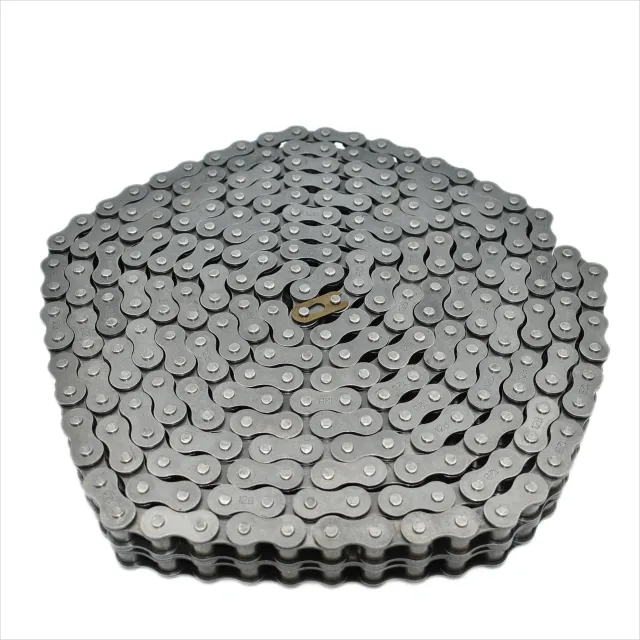
¿Cuáles son las ventajas de utilizar una cadena de transmisión autolimpiante?
El uso de una cadena de transmisión autolimpiante ofrece varias ventajas, que se detallan a continuación:
1. Rendimiento mejorado: Las cadenas de transmisión autolimpiables están diseñadas para eliminar eficazmente los residuos, la suciedad y los contaminantes que se acumulan en la cadena durante su funcionamiento. Al mantener la cadena limpia, se garantiza un rendimiento óptimo y se evita la acumulación de residuos que pueden afectar su movimiento, el acoplamiento con las ruedas dentadas y la eficiencia general.
2. Mantenimiento reducido: Con una cadena de transmisión autolimpiante, la necesidad de limpieza y mantenimiento manual frecuentes se reduce significativamente. El diseño de la cadena incluye características como placas de forma especial, barras laterales curvas y componentes adicionales que impiden activamente que los residuos se adhieran a la cadena o entren en sus zonas críticas. Esto reduce el tiempo y el esfuerzo necesarios para las tareas de limpieza y mantenimiento, lo que se traduce en ahorro de costes y una mayor productividad.
3. Mayor vida útil de la cadena: El mecanismo de autolimpieza de estas cadenas contribuye a prolongar su vida útil. Al eliminar eficazmente los residuos y evitar la acumulación de contaminantes, la cadena sufre menos desgaste. Esto reduce su elongación, minimiza la fricción interna y disminuye el riesgo de fallos prematuros. En consecuencia, mejora la durabilidad y la vida útil general de la cadena.
4. Mayor fiabilidad: Las cadenas de transmisión autolimpiables contribuyen a una mayor fiabilidad y un rendimiento constante. La ausencia de acumulación de residuos garantiza un acoplamiento suave con las ruedas dentadas, evitando el deslizamiento, el atasco o las interrupciones repentinas en la transmisión de potencia. El funcionamiento fiable de la cadena se traduce en un mayor tiempo de actividad, una reducción del tiempo de inactividad y una mayor eficiencia general del sistema.
5. Adecuadas para entornos exigentes: Las industrias y aplicaciones que operan en entornos con altos niveles de polvo, suciedad u otras partículas se benefician enormemente de las cadenas de transmisión autolimpiables. Se utilizan comúnmente en industrias como la agricultura, la construcción, la minería y la manipulación de materiales, donde la exposición a entornos difíciles es frecuente. La función de autolimpieza ayuda a mantener el rendimiento y la fiabilidad de la cadena incluso en estas condiciones adversas.
Es importante destacar que, si bien las cadenas de transmisión autolimpiables ofrecen ventajas significativas, la inspección y el mantenimiento regulares siguen siendo necesarios para garantizar su rendimiento óptimo. Monitorear el estado de la cadena, aplicar la lubricación adecuada y corregir cualquier signo de desgaste o daño son esenciales para maximizar los beneficios de las cadenas de transmisión autolimpiables y asegurar su fiabilidad a largo plazo.
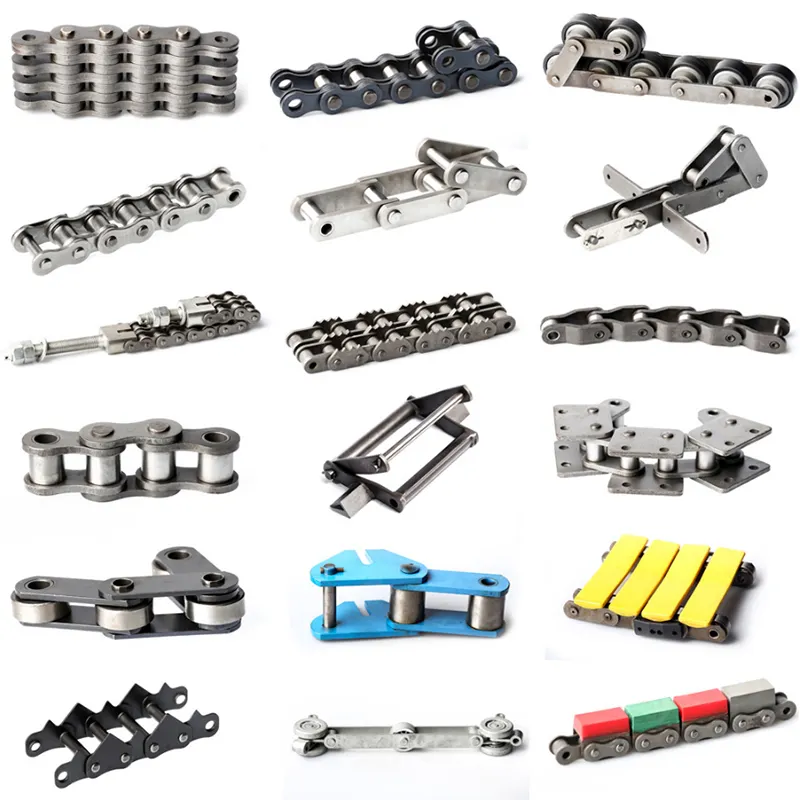
¿Qué tipos de cadenas de transmisión existen?
Existen varios tipos de cadenas de transmisión, cada una diseñada para adaptarse a aplicaciones y condiciones de funcionamiento específicas. Estos son algunos tipos comunes:
- Cadenas de rodillos: Las cadenas de rodillos son el tipo de cadena de transmisión más utilizado. Están compuestas por placas interiores y exteriores, pasadores, casquillos y rodillos. Los rodillos ayudan a reducir la fricción y facilitan un movimiento suave.
- Cadenas silenciosas: Las cadenas silenciosas, también conocidas como cadenas de dientes invertidos o cadenas dentadas, presentan perfiles de dientes especiales que engranan con las ruedas dentadas correspondientes. Están diseñadas para minimizar el ruido y la vibración, lo que las hace idóneas para aplicaciones que requieren un funcionamiento silencioso.
- Cadenas de hojas: Las cadenas de hojas están construidas con eslabones entrelazados hechos de placas de acero planas. Se caracterizan por su alta resistencia a la tracción y a la fatiga, lo que las hace adecuadas para aplicaciones de alta exigencia y cargas elevadas.
- Cadenas de distribución: Las cadenas de distribución se utilizan en los motores para sincronizar la rotación del árbol de levas y el cigüeñal. Tienen perfiles dentados precisos que engranan con las ruedas dentadas de distribución, lo que garantiza una sincronización exacta y un rendimiento eficiente del motor.
- Cadenas de acero de ingeniería: Las cadenas de acero de ingeniería son cadenas altamente especializadas diseñadas para industrias y aplicaciones específicas. Se utilizan con frecuencia en entornos exigentes como la minería, la silvicultura y la manipulación de materiales.
- Cadenas de plástico: Las cadenas de plástico están fabricadas con materiales plásticos de alta resistencia, como el acetal o el nailon. Ofrecen ventajas como resistencia a la corrosión, ligereza y funcionamiento silencioso. Se utilizan habitualmente en la industria alimentaria, el envasado y otros sectores con estrictos requisitos de higiene.
Estos son solo algunos ejemplos de tipos de cadenas de transmisión. Según la aplicación específica, puede haber otras cadenas especializadas disponibles para satisfacer los requisitos únicos de diferentes industrias y maquinaria.
¿En qué se diferencian las cadenas de rodillos de otros tipos de cadenas de transmisión?
Las cadenas de rodillos, también conocidas como cadenas de eslabones de rodillos, son un tipo de cadena de transmisión de uso común que se distingue de otras cadenas de varias maneras:
- Diseño: Las cadenas de rodillos constan de placas interiores y exteriores, pasadores, casquillos y rodillos. Los rodillos, que giran libremente, ayudan a reducir la fricción y el desgaste, lo que resulta en una transmisión de potencia más suave y eficiente.
- Amplia aplicación: Las cadenas de rodillos son versátiles y se utilizan ampliamente en diversas industrias, incluidas la automotriz, la maquinaria industrial, los equipos agrícolas y los sistemas de transporte.
- Alta capacidad de carga: Las cadenas de rodillos están diseñadas para soportar cargas elevadas y ofrecen una excelente resistencia a la tracción, lo que las hace adecuadas para aplicaciones que requieren un rendimiento de alta resistencia.
- Eficiencia: Las cadenas de rodillos son conocidas por su alta eficiencia en la transmisión de potencia. El diseño de los rodillos minimiza la fricción, lo que se traduce en una menor pérdida de energía y una mayor eficiencia general.
- Rentabilidad: Las cadenas de rodillos son relativamente rentables en comparación con otras cadenas de transmisión especializadas, lo que las convierte en una opción popular en muchas aplicaciones.
Si bien las cadenas de rodillos tienen sus ventajas, es importante tener en cuenta que distintos tipos de cadenas de transmisión pueden ser más adecuados para aplicaciones específicas. Al seleccionar la cadena de transmisión apropiada para una aplicación en particular, se deben considerar factores como la capacidad de carga, la velocidad, el nivel de ruido y las condiciones ambientales.


Editor por CX 16/08/2023