Description du produit
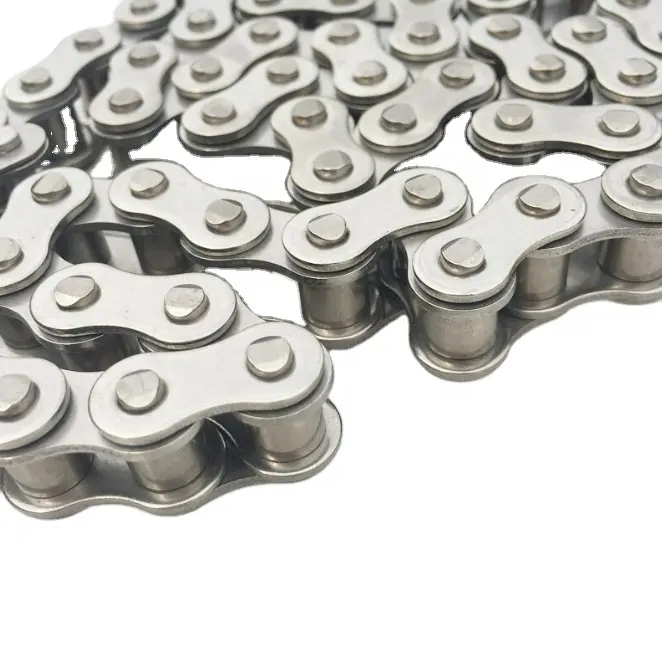
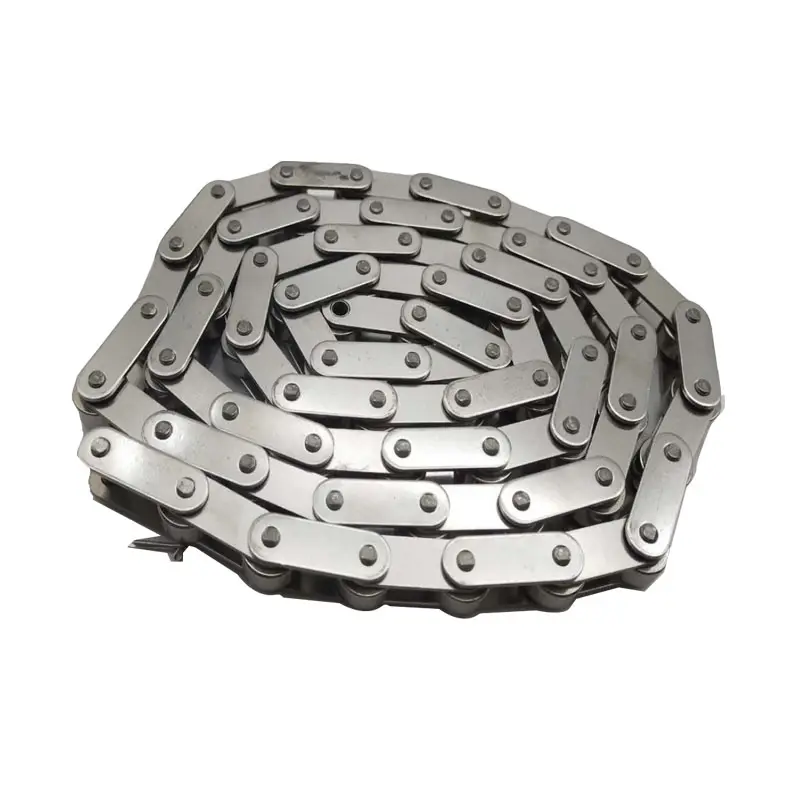
Chaîne à rouleaux industrielle de précision en acier inoxydable à pas court, conforme aux normes ISO/ANSI/DIN, pour transmission de motos.
Description du produit
1. Matériau : Acier inoxydable 304 et 316 / Acier au carbone allié
2. Traitement de surface : Grenaillage / Zingage / Nickelage / Revêtement Dacromet
3. Numéro de chaîne :
35SS-1, 40SS-1, 50SS-1, 60SS-1, 80SS-1, 100SS-1, 120SS-1, 140SS-1;
35SS-2, 40SS-2, 50SS-2, 60SS-2, 80SS-2, 100SS-2, 120SS-2, 140SS-2;
35SS-3, 40SS-3, 50SS-3, 60SS-3, 80SS-3, 100SS-3, 120SS-3, 140SS-3;
4. Application : Les chaînes en acier inoxydable sont utilisées dans de nombreux secteurs industriels, tels que la fabrication de machines, les machines alimentaires, etc. Elles conviennent également aux conditions de températures élevées et basses.
5. Caractéristique :
1. La chaîne peut être utilisée des deux côtés d'une transmission multi-essieux.
2. Installation et remplacement faciles.
3. Il permet d'obtenir un taux de réduction plus important.
4. La chaîne à rouleaux présente une bonne élasticité et une grande résistance. Chaque articulation est lubrifiée à l'huile, ce qui facilite son stockage. Ainsi, comparée à une chaîne à dents rigides, elle offre un bon amortissement et une excellente capacité d'absorption des vibrations.
| Nom du produit | Chaîne à rouleaux en acier inoxydable provenant de Chine |
| Matériaux disponibles | 1. Acier inoxydable : SS304, SS316, etc. |
| 2. Acier allié : 45Mn, 42CrMo, 20CrMo, etc. | |
| 3. Fabrication sur mesure selon votre demande | |
| Traitement de surface | Grenaillage, noircissement, oxygénation, polissage, zingage, nickelage, anodisation, etc. |
| Caractéristiques | Résistant au feu, à l'huile et à la chaleur |
| Critère de conception | ISO DIN ANSI et dessin du client |
| Taille | Dessin du client et norme ISO |
| Emballer | Caisse en bois / conteneur et palette, ou sur mesure |
| Certificat | ISO9001: 2008 |
| Avantage | Qualité supérieure, service optimal, prix compétitifs, livraison rapide |
| Délai de livraison | 20 jours pour les échantillons. 45 jours pour les commandes officielles. |
Photos détaillées
Pour voir plus de produits, veuillez cliquer ici…
Profil de l'entreprise
| Usage: | Chaîne de transmission |
|---|---|
| Matériel: | Acier inoxydable |
| Structure: | Chaîne à rouleaux |
| 80-1: | 1" |
| Taille: | 50ss-1 |
| Autre: | résistance à la corrosion |
| Exemples : |
US$ 0/Mètre
1 mètre (commande minimale) | |
|---|
| Personnalisation : |
Disponible
| Demande personnalisée |
|---|
Comment le choix du tendeur de chaîne influence-t-il les performances d'une chaîne de transmission ?
Le choix du tendeur de chaîne est crucial pour garantir des performances optimales de la chaîne de transmission. Voici une réponse détaillée à cette question :
1. Bon engrènement de la chaîne : Le tendeur de chaîne contribue à maintenir la tension adéquate de la chaîne de transmission, assurant ainsi un bon engrènement entre la chaîne et les pignons. Ceci est essentiel pour une transmission de puissance efficace et un fonctionnement fluide.
2. Contrôle du jeu de la chaîne : Un tendeur de chaîne correctement choisi permet de contrôler le jeu de la chaîne, c’est-à-dire son degré de relâchement. Un jeu excessif peut entraîner des sauts de chaîne, un désalignement et une usure accrue, tandis qu’un jeu insuffisant peut provoquer une tension excessive, accélérant ainsi l’usure de la chaîne et du pignon.
3. Réduction du bruit et des vibrations : L’utilisation d’un tendeur de chaîne adapté contribue à minimiser le bruit et les vibrations dans la transmission. Il permet d’amortir les chocs et les vibrations causés par le mouvement de la chaîne, ce qui se traduit par un fonctionnement plus silencieux et des performances globales améliorées.
4. Durée de vie prolongée de la chaîne : En maintenant une tension optimale, le tendeur de chaîne contribue à prévenir l’usure prématurée et l’allongement de la chaîne de transmission. Ceci prolonge la durée de vie de la chaîne, réduit la fréquence de remplacement et diminue les coûts d’entretien.
5. Compensation de l'usure et de l'allongement : Avec le temps, la chaîne de transmission peut s'allonger. Le tendeur de chaîne compense cet allongement en ajustant sa tension, garantissant ainsi une tension et un engagement optimaux de la chaîne avec les pignons. Ceci assure un fonctionnement constant et prévient les sauts et les déraillements.
6. Adaptabilité aux conditions variables : Certains tendeurs de chaîne permettent un réglage dynamique de la tension, s’adaptant ainsi aux variations des conditions de fonctionnement telles que les fluctuations de température ou les variations de charge. Cette flexibilité garantit des performances optimales de la chaîne et compense les effets de la dilatation ou de la contraction thermique.
Il est crucial de choisir un tendeur de chaîne compatible avec la chaîne de transmission et les exigences de l'application. Lors du choix d'un tendeur, tenez compte de facteurs tels que le diamètre de la chaîne, la plage de réglage de la tension, les conditions environnementales et les variations de charge. Un contrôle et un entretien réguliers du tendeur sont également essentiels pour garantir son bon fonctionnement et prolonger la durée de vie de la chaîne de transmission.
Quels sont les avantages de l'utilisation d'une chaîne de transmission légère ?
L'utilisation d'une chaîne de transmission légère présente plusieurs avantages. Voici une réponse détaillée à la question :
1. Efficacité accrue : Une chaîne de transmission légère réduit le poids total du système, ce qui améliore l’efficacité énergétique. La masse à déplacer étant moindre, la puissance nécessaire à l’entraînement de la chaîne est réduite, ce qui diminue la consommation d’énergie.
2. Rapport puissance/poids amélioré : La légèreté de la chaîne permet un rapport puissance/poids supérieur. Autrement dit, une chaîne plus petite et plus légère peut transmettre la même puissance qu’une chaîne plus lourde, ce qui la rend idéale pour les applications où la réduction du poids est essentielle, comme pour les équipements portables ou portatifs.
3. Inertie réduite : Le poids réduit de la chaîne de transmission diminue l’inertie du système. Il en résulte une accélération et une décélération plus rapides, ce qui améliore les temps de réponse et les performances globales dans les applications dynamiques.
4. Manipulation et installation simplifiées : Les chaînes de transmission légères sont plus faciles à manipuler et à installer que les chaînes plus lourdes. Elles nécessitent moins d’efforts et de main-d’œuvre lors de l’installation ou de la maintenance, ce qui les rend plus pratiques et permet un gain de temps considérable.
5. Réduction de l'usure : Le poids réduit de la chaîne contribue à diminuer l'usure des autres composants du système, tels que les pignons, les roulements et les arbres. Cela permet d'allonger la durée de vie de ces composants et de réduire la fréquence des opérations de maintenance et de remplacement.
6. Réduction des coûts : L’utilisation d’une chaîne de transmission légère permet de réaliser des économies de plusieurs manières. La consommation d’énergie réduite entraîne une baisse des coûts d’exploitation, et le poids allégé peut permettre l’utilisation de composants de support plus petits et moins coûteux.
Il est important de noter que le choix d'une chaîne de transmission légère doit être adapté aux exigences spécifiques de l'application. Des facteurs tels que la capacité de charge, la vitesse, l'environnement d'exploitation et la compatibilité avec les autres composants du système doivent être pris en compte afin de garantir que la chaîne légère réponde aux exigences de performance et de durabilité de l'application.
Existe-t-il des exigences spécifiques en matière de lubrification pour les chaînes de transmission ?
Oui, les chaînes de transmission nécessitent généralement une lubrification adéquate pour assurer un fonctionnement optimal, réduire l'usure et prolonger leur durée de vie. Voici quelques points clés concernant les exigences de lubrification des chaînes de transmission :
- Lubrification adéquate et efficace : Il est important de maintenir la chaîne correctement lubrifiée afin de minimiser la friction et l’usure entre ses composants. La lubrification contribue à réduire la production de chaleur et empêche le contact métal sur métal, ce qui peut entraîner une usure prématurée et une défaillance.
- Choix du lubrifiant : Le choix du lubrifiant adapté est essentiel pour des performances optimales de la chaîne. Plusieurs facteurs sont à prendre en compte : la température d’application, les conditions de charge, la vitesse et les conditions environnementales. Le lubrifiant doit présenter une bonne adhérence, résister à l’oxydation et assurer une protection suffisante des surfaces de la chaîne.
- Intervalle de lubrification approprié : Une lubrification régulière à intervalles appropriés est nécessaire pour maintenir les performances de la chaîne et réduire les risques d’usure excessive. La fréquence de lubrification dépend des conditions d’utilisation et du lubrifiant spécifique employé. Les fabricants fournissent généralement des recommandations concernant les intervalles de lubrification en fonction du type de chaîne et de son application.
- Application efficace du lubrifiant : Une application correcte du lubrifiant est essentielle pour assurer une couverture uniforme et une bonne pénétration dans les composants de la chaîne. Le lubrifiant doit être appliqué sur les plaques des maillons internes, les surfaces des rouleaux et les interfaces axe-bague. Tout excès de lubrifiant doit être éliminé afin d’éviter l’accumulation et la contamination.
- Considérations environnementales : Dans certains environnements, notamment poussiéreux ou sales, la chaîne peut nécessiter une lubrification plus fréquente afin d’éviter la pénétration de contaminants et de maintenir un film lubrifiant adéquat. De plus, pour les applications à haute température ou à grande vitesse, des lubrifiants spécifiques peuvent être nécessaires.
- Inspection et entretien réguliers : Outre une lubrification adéquate, l’inspection et l’entretien réguliers de la chaîne de transmission sont essentiels. Cela comprend la vérification des signes d’usure, de la dégradation du lubrifiant et de la tension de la chaîne. Tout composant endommagé ou usé doit être remplacé rapidement afin d’éviter une rupture de la chaîne.
Le respect des recommandations du fabricant et des exigences spécifiques de lubrification de la chaîne de transmission contribuera à garantir des performances optimales, à réduire l'usure et à prolonger la durée de vie de la chaîne.


Édité par CX le 03/08/2023