제품 설명
제품 설명
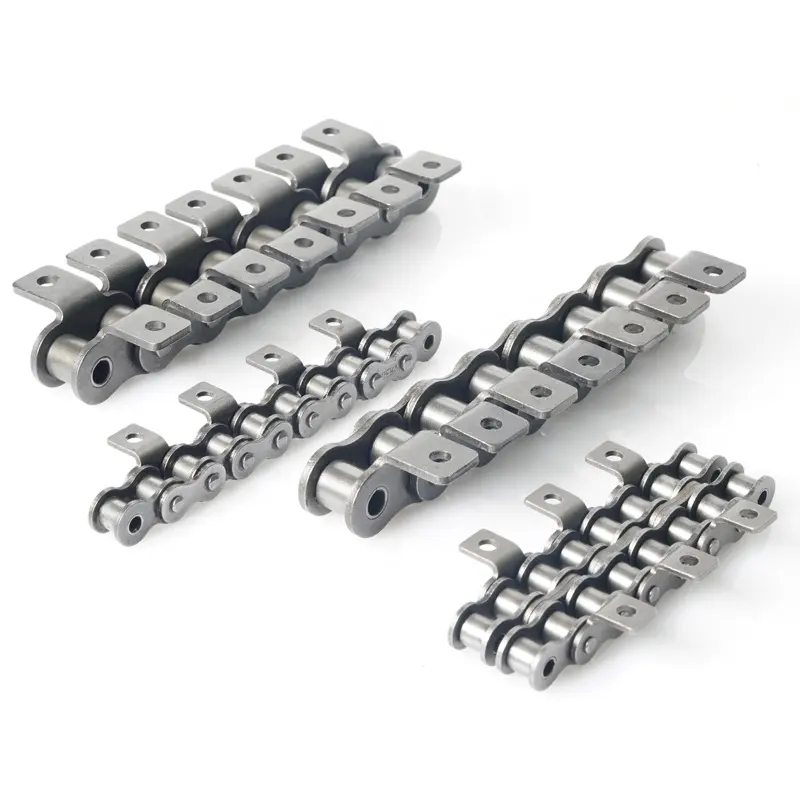
Pitch P=100, 125, 150, 152.4, 160, 200mm with attached plate conveyor chain according to drawing
Rollers are available: small roller (S type), large roller (P type), convex edge roller (F type)
Roller diameters are 36, 42, 50, 60, 70, 85, 100, 120mm etc.
Chain plates are available: single side horizontal CHINAMFG plate attached plate, single side bent plate with ears and double holes type A2, double side bent plate type K2. The chain plate thickness is 4, 5, 6, 7, 8, 10, 12 mm. The width of the chain plate is 25, 30, 35, 40, 50, 60, 70 mm, etc.
Pin diameters are 10, 12, 15, 18, 21, 25mm, etc.
M series metric conveyor chains are available in the following models: M56, M80, M112, M160, M224, M315.
M315,the dimensions are in accordance with the standard GB8350-87.
And can be matched with sprockets.
Product Attribute
| Product Name | Conveyor Chians |
| Available materials | carbon steel, alloy steel,stainless steel |
| OEM customisation according to your requirements | |
| Surface Treatment | Shot peening, Zinc-plated, Nickel-plated, Anodized, etc. |
| 성능 | High temperature resistant Abrasion resistant |
| Reference standards | ISO,DIN,ANSL |
| Customised drawings | YES |
| Certificates | ISO9001:2008 SGS brand TV |
| Delivery time | 20 days for samples. 45 days for official order. |
| 포장 | Plastic Bag + Cardboard Box + Wooden |
Product Parameters
우리의 장점
Company Advantages:
Own Import & Export License, The TV trade mark registered successfully in many countries, Sales network spread all over China, Products export to 65 countries in 5 continents.
Membership:
1. The member of China General Machine Components Industry Association.
2. The member of China Chain Transmission Association.
3. The member of China Chain Standardization Association.
4. The member of China Agricultural Association Machinery Manufacturers.
With our excellent trained staffs and workers, advanced and efficient equipments, completely sales network, strict QA systems. You are confidence that our premium qualified chain can meet all customers’ specification and strictest quality standards.
Please do not hesitate to contact us for more information on how TransVision products can meet your industries demands at highly competitive pricing.
Quality First, Clients Uppermost.
Product Categories
WHY CHOOSE US
Comprehensive Product Portfolio We produce and supply a wide range of power transmission
products including drive chains, leaf chains, conveyor chains, agricultural chains, sprockets, and
couplings. This one-store-for-all shopping experience will significantly reduce your searching costs while
guarantee youfind what you want at 1 click.
Value Choice Products Our products are the best combination of quality and price, and you get what
you want within your budgets
Seasoned Sales Associates and Engineers We have 15 seasoned sales associates and 5 engineers;
on our team at your disposal any time when you need a helping hand. They are well trained with industry
know-now and will always respond to your requests within 24 hours.
100% Customer Retention Rate Our regular customers from overseas come back not just for our
premium quality products, but for the superior services that we’ve provided over the years.
자주 묻는 질문
Q1: What’s your average lead time?
A: It varies. Our regular end-to-end lead time is 1-2 months.. We also provide express shipments for rush orders. For details,please consult our sales associate.
Q2: Is your price better than your competitors given the same quality?
A: Definitely YES. We provide the most competitive price in the power transmission industry. If price disparity exists, we’ll be more than happy to do a price match.
Q3: Can you make chains according to my CAD drawings?
A: Yes. Besides the regular standard chains, we produce non-standard and custom-design products to meet the specific technical requirements. In reality, a sizable portion of our production capacity is assigned to make non-standard products.
Q4: Can we inspect the goods before shipment?
A: Yes. You or your representative or any third-party inspection party assigned is allowed access to our facility and do the inspection.
Q5: What kind of payment method is acceptable for your mill?
A: We’re flexible. We take T/T, L/C, or any other online payment methods so long as it’s applicable for you.
Q6: What if I have any other questions?
A: Whenever in doubt, you’re always encouraged to consult our sales associate any time – They will help you to your satisfaction.
| 재료: | Alloy |
|---|---|
| 구조: | Hollow Chain |
| 표면 처리: | Electroplating |
| 맞춤 설정: |
사용 가능
| 맞춤형 요청 |
|---|
.shipping-cost-tm .tm-status-off{background: none;padding:0;color: #1470cc}
|
배송비:
단위당 예상 운송비. |
배송비 및 예상 배송 시간에 관한 정보입니다. |
|---|
| 결제 방법: |
|
|---|---|
|
초기 납부금 전액 지불 |
| 통화: | 미국$ |
|---|
| 반품 및 환불: | 제품 수령 후 최대 30일 이내에 환불을 신청할 수 있습니다. |
|---|

What are the advantages of using a high-speed transmission chain?
Using a high-speed transmission chain offers several advantages in various applications. Here’s a detailed answer to the question:
1. Efficient Power Transmission: High-speed transmission chains are specifically designed to handle increased rotational speeds while maintaining efficient power transmission. They allow for the transfer of power from the driving source to the driven components with minimal energy loss.
2. Increased Productivity: High-speed transmission chains enable faster operation, resulting in increased productivity. In applications where high-speed operation is crucial, such as production lines or automated systems, using a high-speed chain can significantly reduce cycle times and improve overall efficiency.
3. Reduced Downtime: The ability of high-speed transmission chains to handle increased speeds can contribute to reduced downtime. By maintaining smooth and reliable power transmission even at high rotational speeds, these chains help minimize the risk of chain failure or damage, thus reducing costly downtime for repairs or replacements.
4. Compact Design: High-speed transmission chains are often designed to be more compact and lightweight compared to standard chains. This allows for easier installation in space-constrained applications and reduces the overall weight of the system.
5. Precision and Accuracy: High-speed transmission chains are engineered to have minimal backlash and precise engagement, ensuring accurate positioning and movement. This is particularly important in applications that require precise control or synchronization, such as CNC machines, robotics, or high-speed printing presses.
6. Specialized Materials and Coatings: High-speed transmission chains may incorporate specialized materials and coatings to enhance their performance at higher speeds. These materials and coatings are designed to reduce friction, wear, and heat generation, improving the chain’s durability and extending its lifespan.
7. Customization Options: High-speed transmission chains can be customized to meet specific application requirements. This includes selecting the appropriate pitch size, material, and design features to ensure optimal performance and reliability at high speeds.
It’s important to consider the specific requirements of the application, including the desired speed range, load capacity, and environmental conditions when selecting a high-speed transmission chain. Consulting with experts or manufacturers can help determine the most suitable chain for achieving high-speed operation while maintaining reliability and performance.

How does the choice of lubrication method impact the performance of a transmission chain?
The choice of lubrication method plays a crucial role in the performance and longevity of a transmission chain. Here’s a detailed answer to the question:
1. Reduced Friction and Wear: Proper lubrication ensures a thin film of lubricant between the moving parts of the transmission chain, reducing friction and minimizing wear. This helps to maintain the integrity of the chain’s components, such as pins, rollers, and bushings, by preventing metal-to-metal contact and reducing surface damage.
2. Heat Dissipation: Lubrication helps in dissipating heat generated during the operation of the transmission chain. By reducing friction and providing a cooling effect, the lubricant helps to prevent overheating, which can lead to premature wear, deformation, or failure of the chain.
3. Corrosion Protection: Lubricants often contain additives that offer corrosion protection to the transmission chain. These additives create a protective barrier against moisture, chemicals, and other corrosive elements, preventing rust formation and maintaining the chain’s performance in corrosive environments.
4. Noise Reduction: Adequate lubrication reduces the noise generated by the movement of the transmission chain. The lubricant acts as a cushion between the contacting surfaces, dampening vibrations and minimizing the noise levels produced during operation. This contributes to a quieter and smoother chain operation.
5. Extended Lifespan: Proper lubrication helps to extend the lifespan of the transmission chain. By reducing friction, wear, and the accumulation of debris, lubrication minimizes the stress on the chain’s components, resulting in improved durability and reduced likelihood of premature failure.
6. Operational Efficiency: A well-lubricated transmission chain operates with higher efficiency. With reduced friction, the chain experiences less power loss, enabling more effective power transmission. This leads to improved overall system efficiency, reduced energy consumption, and lower operating costs.
7. Contamination Prevention: Lubrication acts as a barrier, preventing contaminants, such as dust, dirt, and debris, from entering the chain’s components. This helps to maintain the cleanliness of the chain, reducing the risk of abrasive wear and preserving the integrity of its parts.
It’s important to consider the specific operating conditions, such as temperature, speed, load, and environment, when selecting the lubrication method for a transmission chain. Factors such as the viscosity, temperature range, and compatibility of the lubricant with the chain material should be taken into account to ensure optimal lubrication performance.

What are the main differences between standard and heavy-duty transmission chains?
Standard and heavy-duty transmission chains are designed to meet different load and performance requirements. Here are the main differences between these two types:
- Load Capacity: Heavy-duty transmission chains are built to handle higher loads and provide greater strength compared to standard chains. They are designed to withstand heavier and more demanding applications.
- Construction: Heavy-duty transmission chains are typically constructed with thicker plates, larger pins, and stronger components to enhance their durability and load-carrying capacity.
- Size: Heavy-duty transmission chains are often larger in size compared to standard chains to accommodate the increased load requirements.
- Weight: Due to their robust construction, heavy-duty transmission chains tend to be heavier than standard chains.
- Durability: Heavy-duty chains are engineered to have greater wear resistance, fatigue resistance, and overall durability to withstand harsh operating conditions and prolonged usage.
- Applications: Standard transmission chains are suitable for lighter-duty applications where moderate loads are involved, such as light machinery, conveyors, and small equipment. Heavy-duty transmission chains, on the other hand, are designed for heavy machinery, industrial equipment, mining applications, and other demanding environments.
It’s important to consider the specific requirements of your application, including load capacity, operating conditions, and expected lifespan, to determine whether a standard or heavy-duty transmission chain is the right choice.


editor by CX 2023-11-06