Build the selection envelope
The practical route is to move from machine duty to geometry, then to dynamic effects and service conditions, and only then approve a purchase or maintenance action. The classic tradeoff is radial size versus axial width. Multiple strands can carry more power at the same pitch, but they add width and depend on uniform alignment and lubrication across the rows.
の 利用可能なトランスミッションチェーンファミリー is most useful once the problem statement includes multiple-strand chain and larger pitch chain. In this article the controlling verification is to state exactly which requirement a multi-strand option is intended to satisfy. Keeping those facts together gives purchasing and maintenance the same technical basis for the next action.
- Multiple-Strand Chain
- この要件は、別のエンジニアが同じ選択または診断を再現できるように、十分な背景情報とともに記録してください。
- Larger Pitch Chain
- 意思決定を進める前に、図面、測定値、計算結果、または操作記録からこの情報を取得してください。
- Radial Envelope
- これを制御変数として扱い、ジョブレコードにその値、単位、動作状態、および発生源を記録してください。
- Axial Width
- 外観から推測するのではなく、物理的なドライブと最新のサプライヤーデータに基づいてこの項目を確認してください。
- Load Sharing
- このパラメータを使用すると、不適切なオプションを早期に除外し、検証済みの値を最終仕様に保持できます。
Identify the constraint that blocks simplex
Work from determine whether the limiting factor is chain rating, sprocket diameter, shaft spacing, speed, or available pitch. The engineering link is multiple strands are most valuable when a larger single-strand solution violates a radial or dynamic constraint. One useful detail is that if there is abundant space and low speed, a larger simplex chain may be simpler to maintain. Otherwise, adding strands without a real constraint creates unnecessary width and complexity.
Verify at the drive: document the maximum sprocket diameter, available shaft length, target speed, and required design power. Close this check only after you can state exactly which requirement a multi-strand option is intended to satisfy. Keep photographs or dimensions when they help preserve the interface condition.
Compare rating with the supplier strand factor
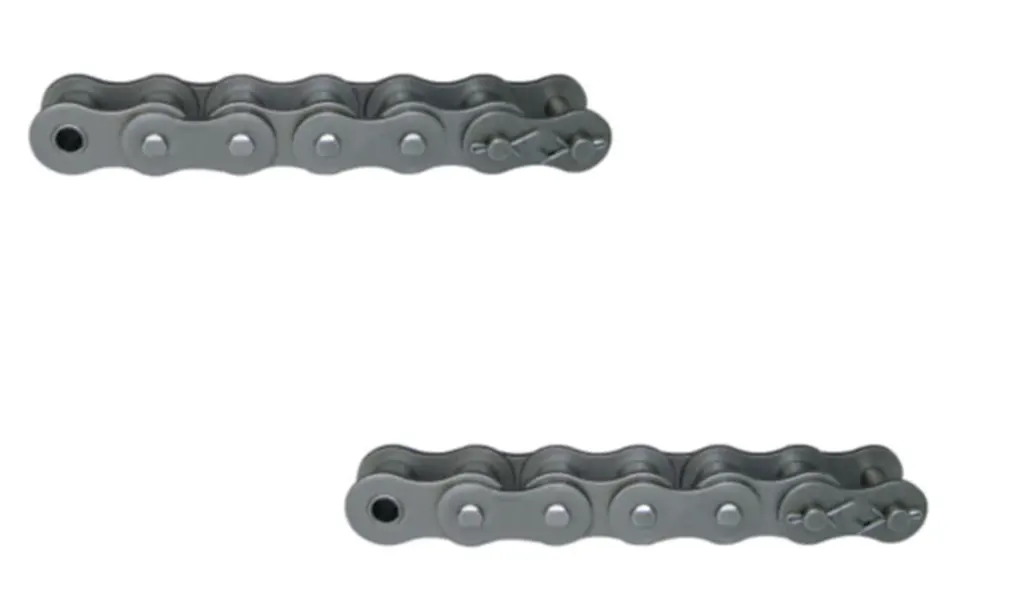
Base the decision on use the manufacturer multi-strand capacity factor for the exact chain series. It matters because two or three rows do not share load with perfect mathematical equality. During service, manufacturing tolerances, sprocket alignment, and joint stiffness affect row-to-row load sharing. A poor assumption can cause multiplying simplex rating directly by strand count can overstate capacity.
Use this confirmation: calculate the duplex or triplex rating using the published factor and the same RPM and tooth-count basis. Proceed when you can verify the multi-strand operating point remains within the supplier table. If readings vary around the chain or sprocket, retain the spread instead of hiding it in one average.
Trade radial envelope against axial width
The controlling action is to compare pitch diameter and outside diameter of the larger simplex sprocket with the face width of the smaller-pitch multi-strand sprocket. Its significance comes from smaller pitch can keep sprocket diameter down while extra rows add capacity. In the field, the wider sprocket may interfere with bearings, shoulders, guards, or adjacent shafts. The failure consequence is solving diameter without checking width can make the drive impossible to assemble.
Check the hardware directly: overlay both candidate sprocket drawings on the shaft and guard layout. Approval requires that you can choose the configuration that fits both radial and axial packaging with service clearance. Write down any uncertainty that still needs a drawing, manual, or supplier response.
Review alignment sensitivity
First, provide shaft parallelism and sprocket axial alignment good enough that all rows engage evenly. That step is tied to a wider chain has more opportunity for side loading and uneven row contact if sprockets are not parallel. A practical observation is that wear marks across rows can reveal poor alignment or hub distortion. Missing it can lead to misalignment can concentrate load in one strand and defeat the theoretical capacity benefit.
For evidence, check straightedge or laser alignment across both sprocket faces and inspect row-by-row wear patterns. Finish when you can confirm comparable engagement and side clearance across all rows. Retain enough context to distinguish a new-chain dimension from a wear-affected measurement.
Deliver lubricant to inner rows
Treat design oil application so lubricant reaches every pin-bushing joint rather than only the outer plates as the control point. The reason is multi-strand chains have internal rows that can be shielded from casual manual application. Real installations also show that surface wetness does not prove lubricant reached the articulating interfaces. The likely consequence of error is inner-row starvation can cause uneven elongation and poor load sharing.
Make the check at the machine: inspect lubricant film at representative connecting links or joints across the chain width. The release criterion is to use a delivery method that wets all rows at the required speed and duty. Record whether the drive was stopped, loaded, warm, cold, clean, or contaminated as relevant.
Compare maintenance and spare strategy
Do not choose the hardware until you consider chain handling weight, sprocket cost, connecting hardware, alignment time, stockholding, and replacement procedure. This matters because multi-strand assemblies can be harder to install while larger simplex components can be heavier and larger in diameter. Remember that the best engineering answer should also be serviceable by the plant team. If ignored, ignoring maintenance can turn a compact design into a long downtime event.
Validate with a repeatable observation: walk through removal, installation, alignment, and lubrication tasks for both options. Move on after you can choose the system that meets the machine constraints with the lowest credible service risk. Preserve the source of any numerical limit that belongs to a specific chain series.
Candidate verification table
| 意思決定ポイント | 検査または計算 | 受諾の証拠 |
|---|---|---|
| Identify the constraint that blocks simplex | document the maximum sprocket diameter, available shaft length, target speed, and required design power | state exactly which requirement a multi-strand option is intended to satisfy |
| Compare rating with the supplier strand factor | calculate the duplex or triplex rating using the published factor and the same RPM and tooth-count basis | verify the multi-strand operating point remains within the supplier table |
| Trade radial envelope against axial width | overlay both candidate sprocket drawings on the shaft and guard layout | choose the configuration that fits both radial and axial packaging with service clearance |
| Review alignment sensitivity | check straightedge or laser alignment across both sprocket faces and inspect row-by-row wear patterns | confirm comparable engagement and side clearance across all rows |
| Deliver lubricant to inner rows | inspect lubricant film at representative connecting links or joints across the chain width | use a delivery method that wets all rows at the required speed and duty |
| Compare maintenance and spare strategy | walk through removal, installation, alignment, and lubrication tasks for both options | choose the system that meets the machine constraints with the lowest credible service risk |
| For this article, do not close the job until the multiple-strand chain evidence and every critical mating interface are recorded together. | ||
この問題に関連するハードウェアのより広い範囲については、以下を参照してください。 review multi-strand sprocket configurations. Use that page only as context for multi-strand versus larger simplex roller chain; approve the real drive from measured interfaces, current ratings, and the machine duty described in this article.
What disqualifies a chain choice
Release check: state exactly which requirement a multi-strand option is intended to satisfy.
Release check: verify the multi-strand operating point remains within the supplier table.
Release check: choose the configuration that fits both radial and axial packaging with service clearance.
Release check: confirm comparable engagement and side clearance across all rows.
Selection questions engineers ask
Issue the final chain specification
A finished selection decision should let another engineer reproduce it without relying on memory. Keep multiple-strand chain, larger pitch chain, the final check for “Compare maintenance and spare strategy,” and the governing catalog or drawing revision together. If another chain architecture becomes relevant, the チェーン駆動エンジニアリングソリューション これは出発点であり、記録された入力データの代替となるものではありません。
For an application-specific review, send the application data to the chain engineering team and identify what is known versus what remains uncertain. Include the values for multiple-strand chain and larger pitch chain, plus the current condition of radial envelope. A supplier can then evaluate a bounded engineering question instead of trying to infer the machine from a chain designation alone.
Send the operating condition, multiple-strand chain, larger pitch chain, layout evidence, and the unresolved interface so the next decision is based on machine data rather than assumption.